The development of ideas for TfLD is not happening in a vacuum.
Here are links to relevant policies & strategies, evidence and data and examples from elsewhere.
These pages will build as ideas develop and as more people get involved.
Policy & Strategies
There are three key relevant local policies
This is the current Local Transport Plan. This sets overall strategy – and so priorities – to guide delivery.
With the emergence of the Cumbria Combined Authority, the CCA will be responsibility for strategy and the two Unitary Authorities (Westmorland & Furness and Cumberland Councils) for delivery. How this is plays out will become clearer over the next year and is a main focus for TfLD.
- The Lake District Partnership Plan 2026-2031
A Management Plan for the National Park and World Heritage Site 2026-2031
This sets 16 planning policies for the Lake District framed by the vision and nine broad ambitions.The Lake District National Park Partnership comprises 24 partners who together agree the Management Plan. It is overseen by the Lake District National Park Authority. The LDNPA lead on STEAM modelling of annual visitor volumes and economic value and trends in these over the years for the National Park specifically.
- A Destination Management Plan (DMP) for CumbriaVision – Famed for our world-class landscapes and culture. By 2040 Cumbria will be Britain’s most vibrant and sustainable rural destination, boasting a reputation for quality, welcome, and an adventure for everyone – bringing benefits for our visitors, economy, nature and communities.
Cumbria Tourism as the Visit Britain Local Visitor Economic Partnership for the area led the development of the DMP and oversee its delivery. Cumbria Tourism also lead on the collection of core data on the tourism sector including the Visitor Survey (every 3-5 years) and other relevant data collection and analysis of the sector.
At regional or national scale:
TfN’s role is to
- Advise the Secretary of State on pan-northern transport priorities
- Set a long-term regional strategic transport plan
- Advise on major rail and road investment decisions
- Work with the Department for Transport on the North’s franchised rail services via Rail North Partnership
This new (April 2026) national Strategy frames priorities for transport across England – see graphic.
A clear vision for transport is linked to three principles, through which strategy and delivery takes place via sub-regional bodies – in our case, the Cumbria Combined Authority.
TfLD will be working to make sure that our ambitions align with this strategy in order for the ideas to influence and fit well with emerging CCA strategy.
Evidence
How many people?
- At the 2021 census, there were 38,993 people living in the Lake District. The ONS summary of national park populations provides more detailed breakdown of other aspects of the population – such as ages, labour markets etc.
- In 2024, there were about 17.7m visitors to the Lake District. Taking into account the number of nights that overnight visitors stay, this is the equivalent of 26.9m “visitor days”.
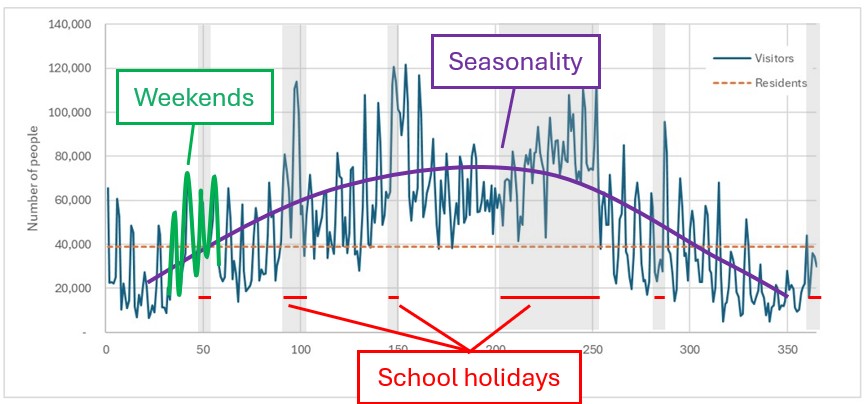
- The figure shows an estimate of the number of visitors against the number of residents on any day of a typical year. These estimates suggests that there are more visitors than residents in the Lake District on 212 days of the year, and on the busiest days there are up to five time the number of visitors as residents across the Lake District.
So how should a transport system be designed – that caters for the day-to-day needs of residents all year round whilst moving the 18m annual visitors? And how do we make sure that businesses can access workforce? Where should the priorities lie and how are these balanced?
- Whilst the idea of a visitor season is well established, it’s useful to break this down into three parts when it comes to designing transport systems: the annual season, school holidays and weekends. The three valleys work show that different places are “busy” differently: For example, Hawkshead has a distinct seasonal bulge peaking in the summer holidays whereas Langdale is very busy at weekends for the 9 months from February to November.
This becomes significant when designing resilient, viable and attractive transport systems.
What do people want?
Work led by Action with Communities in Cumbria (2024) revealed appetites for what residents and visitors want out of the transport system:
This supports other local evidence both local and national that generally that there is a general public desire for better, integrated public transport and better conditions for walking and cycling. There is also a pragmatism about how cars fit into this system, but the overall call is for the emphasis to be shifted to providing widespread public transport and active travel options for local trips.
Economics?
- Whilst the Lake District represents only 7.6% (c. 39,000) of the county’s population (c. 511,000), Cumbria Tourism’s analysis indicates that it
- contributes 52% to the county’s tourism revenue (£2.4bn of £4.6bn),
- employs over 22,000 people via the tourism sector.
It therefore needs to be world-class quality for the county’s economic health
- How people travel is changing, but the Lake District is still basically set up for mass car-based tourism.
The next generation of visitors – especially younger urban adults – are increasingly living lifestyles where cars just don’t figure – for all sorts of reasons; they also are big contributors to visitor economies.
To make the Lake District – and Cumbria’s – tourism economy robust and future-proof, how people travel to and around needs to change
Examples from elsewhere
The new Rural Mobility Centre of Excellence has been established to provide “local and national partners with a dedicated rural mobility policy resource – bringing clarity, direction and coordination to an area that has historically lacked strategic focus”. It is hosted by Transport East – perhaps reflecting the increasingly important role of Combined Authorities in strategy and delivery for rural access and transport. It includes resources on Rural Mobility Innovation (2025), a Compendium of Practice in Rural Mobility (2023) and is developing a database of rural transport best practice case studies.
The EU SMARTA programme remains a great resource of what works well in rural transport across Europe. Whilst the programme ended in 2024, the European Rural Mobility Network (ERMN) was set up to enable the sharing of knowledge and experiences among local authorities, practitioners, and experts on rural mobility.
A wide range of examples of best practice in visitor travel to and around rural visitor destinations was brought together in the Churchill Fellowship (2023).